The Network and Information Security Directive 2 — formally Directive (EU) 2022/2555 — is now in force across EU member states. With the EU-wide enforcement deadline of October 2024 passed and Germany's national implementation law (NIS2UmsuCG) entering into force on December 6, 2025, the compliance window has closed for most organizations in Europe.
This guide covers everything EU organizations need to know: who must comply, what Article 21 requires, how penalties work, how incident reporting works, and what a compliant communication infrastructure looks like in practice.
What Is the NIS2 Directive?
NIS2 is the EU's updated legislative framework for cybersecurity, replacing the original NIS Directive from 2016. It was formally adopted in January 2023 and required EU member states to transpose it into national law by October 17, 2024.
The directive takes an "all-hazards" approach, addressing not just cyberattacks but also physical disruptions to critical services. Compared to NIS1, NIS2 significantly expands scope — the European Commission estimates it covers organizations across 18 critical sectors, with targeted amendments proposed in January 2026 to ease compliance for approximately 28,700 smaller companies.
Key changes from NIS1 to NIS2 include stricter incident reporting timelines, mandatory management accountability, supply chain security requirements, and minimum technical security baselines defined in Article 21.
NIS2 Member State Transposition: Where Things Stand
Several EU countries missed the October 2024 transposition deadline, prompting the European Commission to open infringement proceedings against 23 member states in November 2024.
Germany's implementation law — officially the NIS2UmsuCG (NIS-2-Umsetzungs- und Cybersicherheitsstärkungsgesetz) — was published in the Federal Law Gazette on December 5, 2025, and entered into force on December 6, 2025, with no transition period. The number of regulated entities in Germany is expected to grow from approximately 4,500 to around 29,000 organizations. Registration with the BSI (Federal Office for Information Security) must be completed within three months of the law taking effect.
France is still finalizing its national legislation through a Critical Infrastructure Resilience Bill. Italy, Belgium, Denmark, Greece, Hungary, and Slovakia have already transposed the directive. Organizations operating across multiple member states should monitor each jurisdiction separately, as enforcement timelines and supervisory procedures differ.

Who Must Comply With NIS2?
NIS2 applies to medium and large organizations operating in sectors the EU considers critical. Organizations are classified as either essential entities or important entities — a distinction that affects supervisory oversight intensity, not the security requirements themselves.
Essential entities include organizations in highly critical sectors: energy (electricity, gas, oil, hydrogen), transport (air, rail, road, maritime), banking, financial market infrastructure, healthcare, drinking water, wastewater, digital infrastructure (cloud providers, data centers, DNS providers, IXPs), ICT service management, public administration, and space.
Important entities include organizations in other critical sectors: postal and courier services, waste management, chemicals, food production and distribution, manufacturing of medical devices and critical products, digital providers (online marketplaces, search engines, social networks), and research organizations.
Size thresholds are:
- Large organizations — 250+ employees, €50M+ annual turnover or €43M+ balance sheet — in covered sectors are classified as essential entities.
- Medium organizations — 50–250 employees, up to €50M turnover — are classified as important entities.
- Small and micro enterprises — under 50 employees, under €10M turnover — are generally exempt, unless they are the sole provider of a critical service in their country or operate as qualified trust service providers, DNS providers, or TLD registries.
NIS2 also applies to non-EU companies that provide services to EU organizations. International cloud providers, SaaS vendors, and managed service providers serving EU clients may fall within scope regardless of where they are headquartered, and must designate an EU representative.

The 10 NIS2 Security Requirements Under Article 21
Article 21 of the NIS2 Directive defines a minimum baseline of security measures all essential and important entities must implement. These are not optional — they form the legal foundation of any NIS2 compliance program.
1. Risk analysis and information system security policies. Organizations must have documented policies for identifying, assessing, and managing cybersecurity risks. These policies must be approved by senior management and reviewed on a regular basis.
2. Incident handling. Organizations must have formal procedures for detecting, responding to, and recovering from cybersecurity incidents. This includes defined roles, escalation paths, and post-incident reviews.
3. Business continuity and crisis management. Backup management, disaster recovery, and crisis response plans are mandatory. These must address how services will be maintained or restored during and after a major cyber incident.
4. Supply chain security. Organizations must assess the cybersecurity practices of their direct suppliers and service providers, including reviewing contractual security obligations and performing supplier risk assessments. Suppliers outside NIS2 scope may still face indirect obligations through customer contracts.
5. Security in systems acquisition, development, and maintenance. Secure development practices, vulnerability management, and security testing are required for systems used to deliver essential services.
6. Effectiveness assessment policies. Organizations must have mechanisms to test and verify that their security controls work, including audits, penetration testing, and continuous monitoring.
7. Basic cyber hygiene and cybersecurity training. All staff must receive regular security awareness training. Management must be specifically trained to understand the organization's NIS2 obligations — this is explicitly required, not optional.
8. Cryptography and encryption policies. Where technically feasible, data must be encrypted in transit and at rest. Organizations must have formal policies governing how cryptography is used and managed.
9. Human resources security, access control, and asset management. Role-based access controls, least-privilege principles, and strong authentication including MFA are required. Asset inventories must be maintained.
10. Multi-factor authentication and secure communications. MFA must be implemented for all privileged access. Secure communication channels must be used for all sensitive internal and external communications — including emergency and out-of-band communication scenarios.
NIS2 Incident Reporting Requirements
One of the most operationally demanding NIS2 changes is the tiered incident reporting mandate. When a significant cybersecurity incident occurs — defined as one that causes or is capable of causing severe operational disruption — organizations must notify their national CSIRT or competent authority in three phases:
Early warning — within 24 hours of becoming aware of the incident. This initial notification must flag whether the incident is suspected to involve malicious or criminal activity, and whether it has cross-border impact.
Incident notification — within 72 hours, including an initial assessment of the incident's severity, its impact on service delivery, and indicators of compromise.
Final report — within one month of the initial notification, including a full description of the incident, root cause analysis, mitigation measures taken, and any cross-border impact.
This creates a significant operational requirement: organizations must have pre-established, secure communication channels with authorities, clear internal escalation procedures, and the ability to generate detailed technical incident reports rapidly. The teams responsible for this process need dedicated, auditable tools — not general-purpose consumer messaging apps.
For government and public sector teams looking at how to structure their communication infrastructure around these requirements, see how government communication teams approach secure, compliant operations.
NIS2 Penalties and Management Liability
Non-compliance with NIS2 carries both financial and personal consequences that go well beyond previous EU cybersecurity regulations.
For essential entities, administrative fines can reach €10 million or 2% of total annual global turnover, whichever is higher. For important entities, fines can reach €7 million or 1.4% of turnover. Supervisory authorities can also impose binding instructions, mandatory security audits, temporary bans on specific operations, and public disclosure of non-compliance.
Crucially, NIS2 introduces personal liability for management. Senior executives and board members can be held individually responsible for cybersecurity failures. This includes the possibility of temporary bans from holding management positions following a serious incident caused by negligence. As Greenberg Traurig notes in their EU NIS2 analysis, cybersecurity is no longer a back-office IT concern — it is a board-level accountability matter.
If an NIS2 incident also constitutes a GDPR breach, authorities will coordinate enforcement. GDPR monetary fines will generally take precedence for the data breach, but NIS2 non-financial sanctions can still be applied separately for the cybersecurity violation.
NIS2 Compliance Checklist: Key Action Steps
To move from awareness to active compliance, organizations should work through the following actions:
- Confirm whether your organization is classified as an essential or important entity and in which member states.
- Perform a gap analysis against the 10 Article 21 requirements.
- Establish or update your incident response plan to meet the 24/72-hour reporting timelines.
- Audit your supply chain for cybersecurity risks and update supplier contracts to include security obligations.
- Implement MFA across all privileged access and review access control policies.
- Ensure all communication channels used for sensitive information are encrypted and auditable.
- Assign named management accountability for cybersecurity oversight — this is legally required under NIS2.
- Document all security measures and maintain evidence for potential audits.
- Monitor your member state's national transposition timeline and adjust for local legal requirements.
- Conduct staff training and ensure management understands its personal NIS2 obligations.
How Secure Communication Platforms Support NIS2 Compliance
Communication infrastructure sits at the intersection of several NIS2 Article 21 requirements: encrypted communications (requirement 8), access control and MFA (requirements 9 and 10), and incident response coordination (requirement 2). Your team's messaging platform is not peripheral to NIS2 — it is part of the compliance architecture itself.
Organizations must ensure the platforms their teams use to collaborate, share sensitive information, and coordinate during incidents are themselves NIS2-aligned. This means evaluating communication platforms against criteria including end-to-end encryption, data residency and sovereignty, access control capabilities, audit logging, MFA support, and deployment flexibility — especially on-premises options to ensure data does not leave EU jurisdiction.
What Rocket.Chat Provides for NIS2
Rocket.Chat is ISO 27001 certified, SOC 2 compliant, and GDPR-aligned. It can be deployed on-premises, in private cloud environments, or in air-gapped configurations — giving organizations full control over where their communication data resides and who can access it.
Features directly relevant to NIS2 Article 21 requirements include:
- End-to-end encrypted messaging — ensures only intended recipients can access communications, meeting requirement 8 on cryptography and encryption. Learn more about encrypted messaging apps and how encryption standards apply to organizational compliance.
- Message audit panel — provides a complete, exportable record of communication history, supporting both internal review and external audit requirements under NIS2 supervisory processes.
- Role-based access control with MFA enforcement — directly addresses requirement 10 on multi-factor authentication and requirement 9 on access control and asset management.
- Real-time monitoring and customizable alerts — enables detection of anomalous activity or unauthorized access attempts, supporting requirement 6 on effectiveness assessment.
- Device management — ensures only authorized devices can access the platform, reducing attack surface.
For incident response specifically, Rocket.Chat supports the creation of dedicated, encrypted channels for security operations teams — enabling the kind of secure, auditable, out-of-band communication that NIS2's 24-hour early warning requirement demands. For more on how this works in practice, see air-gapped collaboration for teams operating in restricted environments.
Rocket.Chat is also open-source, which means organizations can audit the codebase, customize security configurations, and integrate with existing SIEM and monitoring tools. This supports NIS2's requirement for documented evidence of security measure effectiveness. The platform's organizational security capabilities — including data loss prevention, message retention policies, and admin controls — give security teams the visibility they need to demonstrate compliance.
.avif)
Deployment Flexibility for EU Data Sovereignty
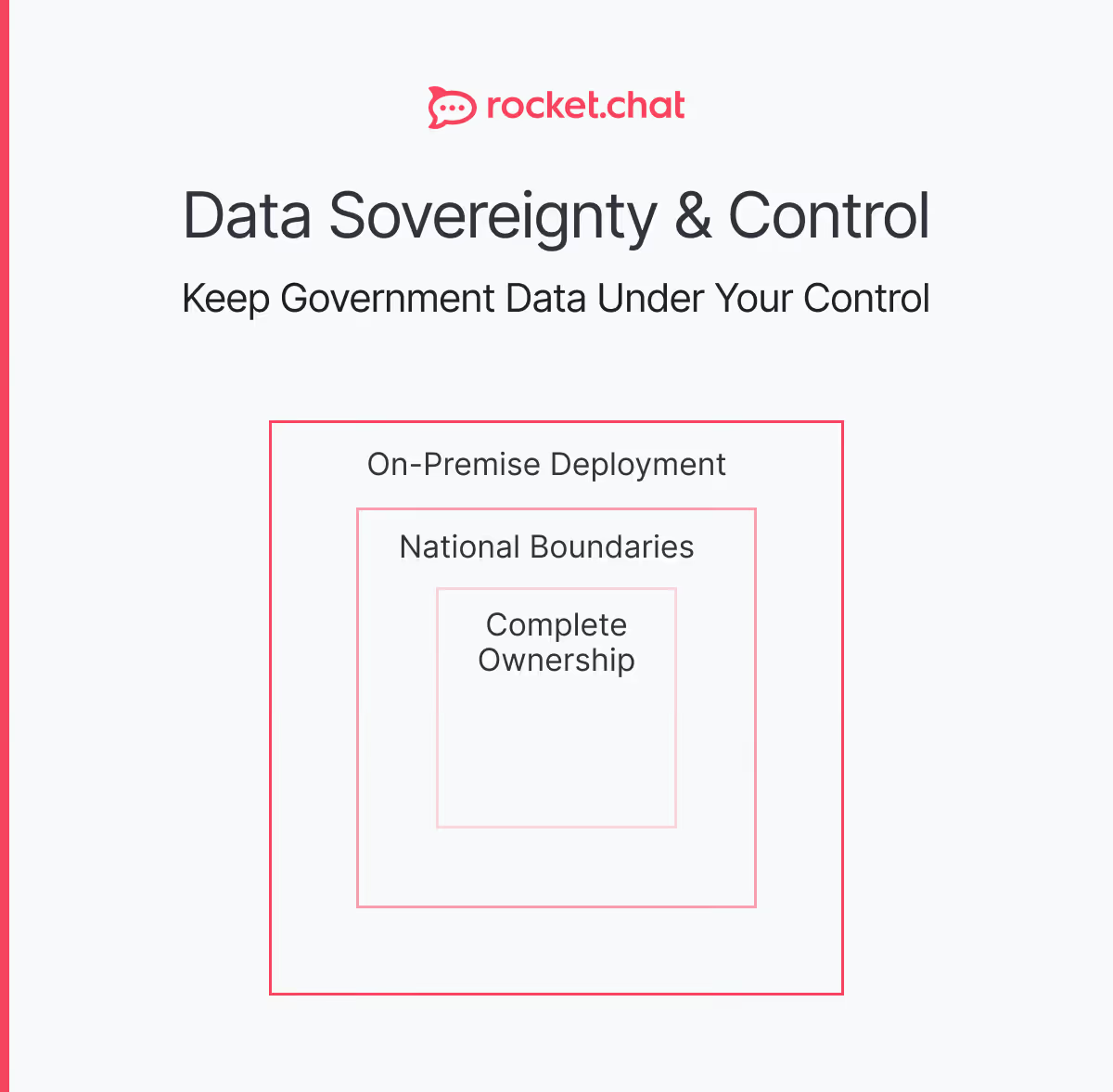
A specific concern for EU organizations under NIS2 is ensuring data does not transit through non-EU infrastructure. Rocket.Chat's self-hosted deployment model addresses this directly: organizations can run the platform entirely within their own infrastructure, in EU-hosted cloud environments, or in completely isolated networks.
For EU government bodies and organizations evaluating sovereign collaboration tools, Rocket.Chat is a sovereign Slack alternative for Europe built with data residency requirements in mind. Teams replacing legacy enterprise tools can also review Microsoft Teams alternatives for European government use cases.
For public sector and government teams specifically, government messaging apps built on open-source infrastructure offer the auditability and deployment control that both NIS2 and national security policies require. Rocket.Chat has been officially recognized for use within the U.S. Department of Defense under the Platform One DevSecOps program, and is deployed by organizations including the World Bank and Credit Suisse.
Choosing the Right Collaboration Stack
Beyond the messaging platform itself, organizations should audit their entire collaboration tool stack against NIS2's supply chain security requirement (requirement 4). Every tool that processes or transmits sensitive organizational communications is within scope. For a practical overview of what to look for, see this guide to secure collaboration tools.
The most secure messaging apps for enterprise use combine end-to-end encryption, on-premises deployment options, and compliance certifications — not just consumer-grade security features. Organizations evaluating tools should also review what encrypted messaging looks like in practice for compliance-driven teams, and how modern chat apps differ in their approach to access control and data residency. Communication security for NIS2-covered organizations requires systematic, documented controls, not ad hoc configurations.
Frequently asked questions about <anything>
NIS2 compliance
Does NIS2 apply to non-EU companies?
What is the difference between essential and important entities under NIS2?
When did Germany's NIS2 law take effect?
Can NIS2 and GDPR fines be applied at the same time?
What makes a communication tool NIS2-compliant?


- Digital sovereignty
- Federation capabilities
- Scalable and white-labeled

- Highly scalable and secure
- Full patient conversation history
- HIPAA-ready

for mission-critical operations
- On-premise and air-gapped ready
- Full control over sensitive data
- Secure cross-agency collaboration
%201.svg)
- Open source code
- Highly secure and scalable
- Unmatched flexibility

- End-to-end encryption
- Cloud or on-prem deployment
- Supports compliance with HIPAA, GDPR, FINRA, and more

- Supports compliance with HIPAA, GDPR, FINRA, and more
- Highly secure and flexible
- On-prem or cloud deployment