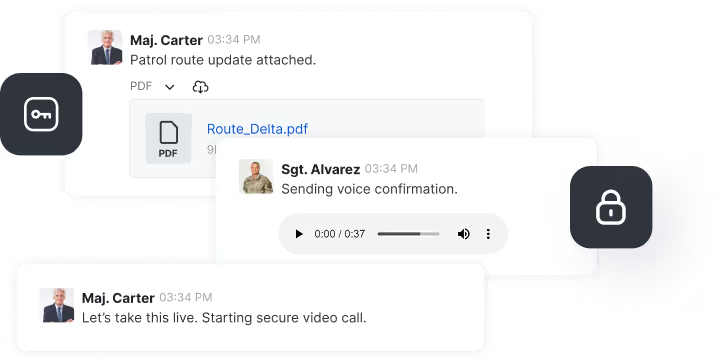
Air-gapped collaboration provides maximum security for defense and government organizations by physically isolating sensitive systems from unsecured networks. This article explores how air-gapped environments enable secure team communication, data sovereignty, and regulatory compliance while maintaining operational effectiveness. Learn about the benefits of air-gapped systems, including protection against cyber threats, enhanced coordination across classification levels, and reliable communication in extreme environments. Discover how modern air-gapped collaboration platforms integrate secure messaging, encrypted video conferencing, and flexible deployment options to support mission-critical operations.
Key takeaways:
- Physical isolation prevents remote cyberattacks and unauthorized data access
- Air-gapped collaboration supports secure communication across multiple classification levels
- Modern platforms enable real-time coordination while maintaining strict security controls
- Flexible deployment options accommodate diverse operational requirements
- Compliance with regulatory frameworks including FedRAMP, ISO 27001, and DoD standards
Protecting sensitive data remains critical for defense and government sectors. The defense sector handles information that, if disclosed, could jeopardize national security and compromise operations.
According to research from Cybersecurity Ventures, worldwide cybercrime costs are projected to reach $10.5 trillion annually by 2025, representing a 15% year-over-year growth rate. The FBI's Internet Crime Complaint Center reported a 10% increase in cybercrime complaints in 2023 compared to 2022, totaling 880,418 incidents.
Additionally, Ransomware as a Service (RaaS) has become a significant threat vector. In 2021, one group, REvil, was responsible for 37% of ransomware attacks, demonstrating how concentrated and sophisticated these threats have become.
The digital battleground is now as important as its physical equivalent. One proven approach to ensure secure mission communication is implementing a self-hosted air-gapped environment. In this scenario, air-gapped collaboration means working with maximum security while accepting limited external connectivity. Teams operate in isolated environments and only share outcomes after following strict security protocols.
This isolation provides exceptional security and prevents data breaches, unauthorized access, and cyber espionage.
This article explores the importance of air-gapped collaboration, its benefits, and how it improves coordination, security, and reliability in regulated sectors.
What is air-gapped collaboration?

An air gap represents a specialized security mechanism where a computer or network is physically isolated from external connections. This isolation creates what researchers at IBM describe as "one of the most stringent security measures organizations can implement."
For example, an air-gapped computer cannot access the internet or other communications networks, ensuring robust protection for stored information.
Understanding air-gapped collaboration
Air-gapped collaboration refers to secure methods of sharing and exchanging data between devices or systems that are physically separated from unsecured networks like the internet.
Unlike traditional communication security platforms that depend on internet connectivity, air-gapped systems function in closed loops, offering secure conduits for sharing sensitive intelligence and coordinating operations.
What does air-gapped collaboration entail?
Air-gapped collaboration technologies deliver high security levels by separating sensitive data from insecure networks. They enable users to connect safely while protecting mission-critical data from external threats.
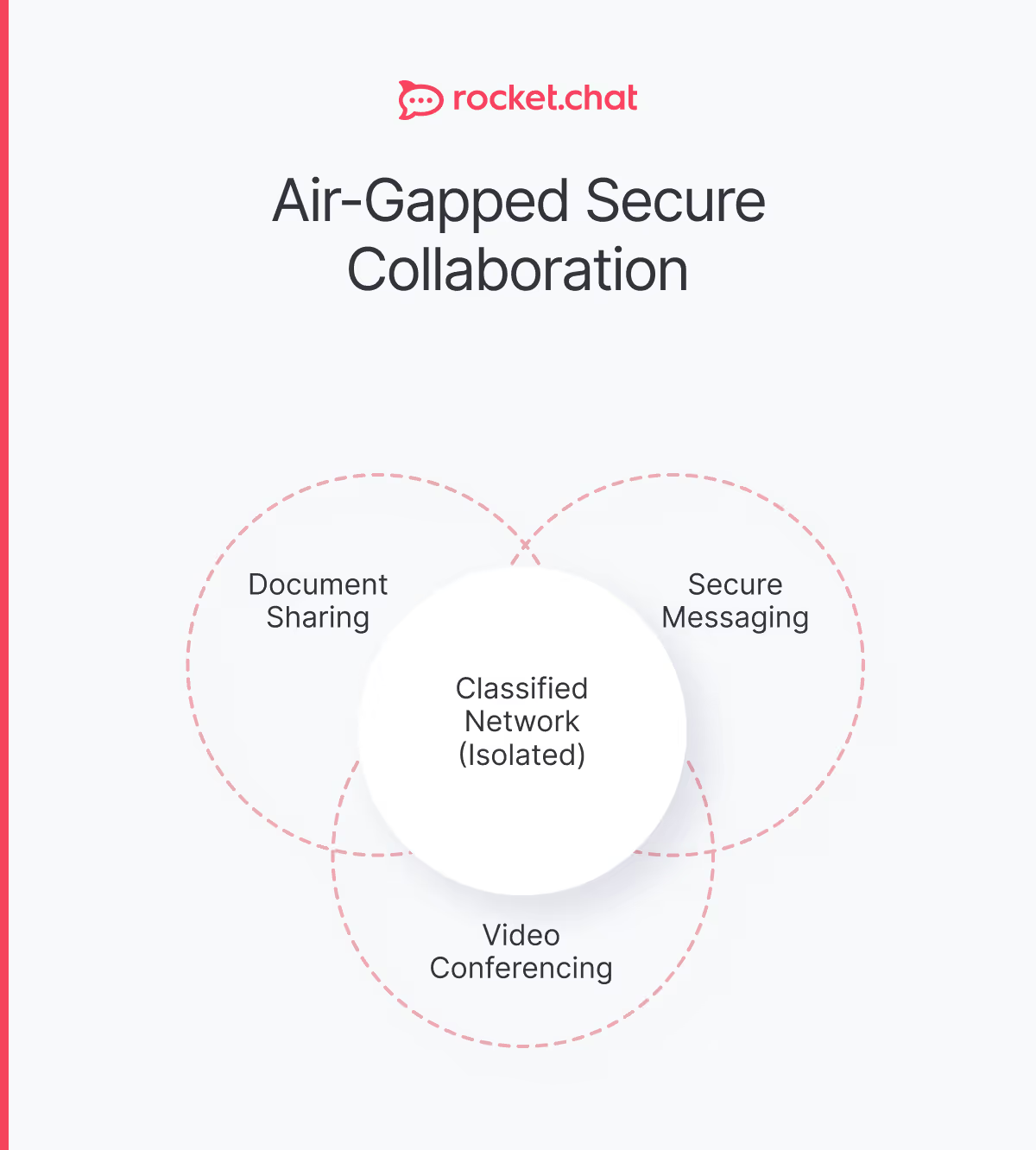
Modern air-gapped collaboration solutions include:
- Secure messaging and chat capabilities
- Encrypted video conferencing
- Project management tools
- Digital whiteboarding
- File sharing with access controls
All features are integrated into a unified interface that maintains security while enabling productivity.
Overall, air-gapped collaboration provides a dependable solution for enterprises seeking to protect important data while maintaining seamless communication. According to a U.S. Government Accountability Office report, federal agencies face increasing risks as malicious actors become more capable of carrying out sophisticated cyberattacks.
Air-gapped environments enable seamless government collaboration within secure perimeters.
Collaboration development by Rocket.Chat, Bluescape, and Pexip
Popular collaboration and communication platforms Rocket.Chat, Bluescape, and Pexip partnered to develop a comprehensive air-gapped collaboration solution tailored exclusively for government and defense organizations.
- Preparedness-focused approach
This partnership delivers a robust solution ensuring data confidentiality while improving operational preparedness and coordination capabilities.
- Classified operation toolkit
Their collective toolkit supports diverse tasks at all classification levels, from secure headquarters to the most remote deployed forces, facilitating mission success across varied operational contexts.

Government and defense: why air-gapped collaboration is essential
Traditional communication channels often fail to meet the rigid security requirements of military and government operations, where information secrecy and integrity are paramount. The reliance on internet-based solutions raises substantial concerns about data breaches and cyber invasions.
Rocket.Chat, Pexip, and Bluescape work together to provide a centralized digital workspace for air-gapped collaboration encompassing chats, meetings, files, planning boards, mission data, and knowledge management.
Air-gapped collaboration delivers numerous advantages, making it an essential approach for defense and government sectors.
Improving coordination
Coordination is essential for successful defense and government operations. Military operations involve numerous groups domestically and globally, necessitating smooth coordination and information exchange.
Air-gapped collaboration provides a secure platform for team chat and unified communication, allowing various government branches, agencies, and partners to interact while successfully maintaining operational secrecy.
Bluescape enables visual interaction across all mission components:
Centralized communication channels: Defense organizations improve operational efficiency by centralizing communication in secure environments.
Mission planning capabilities: Teams can plan missions, discuss strategies, gather feedback, make decisions, and solve challenges in real time.
Single source of truth: The platform provides a unified information repository for data-driven decisions, ensuring operational responsiveness.
Secure collaboration across classification levels
With varying classification degrees for sensitive material, secure communication across clearance levels is critical. Air-gapped environments enable protected messaging and data sharing, meeting the needs of personnel operating at different security levels while minimizing data leakage risks.
Rocket.Chat facilitates communication without compromising data privacy or security. As explored in our guide to encrypted messaging apps, the platform offers notable benefits:
Integration features: Extensive integration capabilities allow secure interaction with partners, agencies, and allies to share sensitive intelligence, regardless of location or tools used.
Encryption: Air-gapped collaboration solutions provide robust encryption and access restrictions to protect sensitive data from unauthorized access or interception.
Compliance: Organizations ensure confidentiality and integrity of mission-critical information by implementing communication channels based on classification levels and adhering to regulatory standards and security policies.
Reliability in extreme environments
Military operations frequently occur in hostile locations and enemy territories where traditional communication infrastructure may be unavailable or degraded.
Air-gapped collaboration systems operate in offline or disconnected modes, guaranteeing reliable communication even in remote or hazardous environments. This capability significantly increases operational effectiveness.
Pexip enables ground forces to deliver clear battlefield intelligence and maintain connectivity even in severe circumstances.
Situational awareness: The platform provides ground forces with tools to successfully relay combat intelligence, deliver real-time updates, and develop comprehensive situational awareness.
Operational readiness: By employing resilient communication technologies, defense organizations overcome logistical challenges and sustain operational readiness in demanding conditions.
Real-time decision support: Commanders gain capabilities to make intelligence-driven decisions and respond rapidly to evolving scenarios.
Specifics of air-gapped collaboration
The integration of Rocket.Chat, Pexip, and Bluescape technologies produces a complete collaboration suite customized for government and defense enterprises, aligned with federal zero trust principles.
These platforms combine to offer a secure, dependable, and unified collaboration environment that safeguards mission-critical information, improves operational preparedness, and establishes situational awareness to ensure mission resilience and success.
.avif)
1. Secure video calls
The ability to conduct encrypted video calls in restricted environments ensures defense personnel communicate confidentially, regardless of location or security clearance.
Secure video conferences are essential for enabling remote collaboration and decision-making, especially when face-to-face meetings are impractical or risky.
Air-gapped collaboration solutions protect video conference privacy and security through encryption and authentication measures, reducing eavesdropping risks or unwanted access.
Features such as participant authentication and granular access control enhance video conference security beyond traditional approaches.
2. Secure messaging
Secure military messaging is critical for real-time communication and information exchange among defense groups.
Air-gapped collaboration solutions offer end-to-end encryption and message integrity verification to prevent important discussions from being compromised.
Regardless of deployment architecture, all security controls incorporated into the system secure mission conversations and data from unauthorized access, interception, and alteration.
The collaboration platform enables private military chat sessions that are completely unreadable without proper credentials due to end-to-end encryption. This approach aligns with best practices for most secure messaging apps in high-security environments.
Additionally,
platforms frequently incorporate message expiration and self-destruct options to preserve sensitive data even after delivery.
3. Flexible deployment options
Air-gapped collaboration platforms allow enterprises to deploy communication services according to their specific needs, whether on-premises, in secure cloud environments, or in completely disconnected configurations.
Deployment flexibility is critical for managing varied infrastructure needs and operational constraints. By offering diverse deployment choices, platforms enable military organizations to customize collaborative infrastructure for specific security, scalability, and compliance requirements.
Hybrid deployment approaches allow seamless integration with legacy systems while leveraging benefits of modern secure collaboration tools.
4. Data sovereignty
Data sovereignty is crucial for protecting sensitive information and adhering to national and international legislation.
Air-gapped collaboration solutions enable enterprises to maintain complete control of their data by hosting communication services in secure on-premises environments.
With 180+ role-based authorization capabilities, encrypted file sharing, and stringent identity validation, the platform controls access to sensitive data with precision.
Comprehensive audit logs and robust data loss prevention procedures enable monitoring of critical information shared within and outside organizational boundaries.
By storing data within national boundaries and under organizational control, defense enterprises reduce data exposure risks and maintain compliance with data protection regulations. This capability represents one of the main requirements for effective organizational security strategies.
5. Regulatory compliance
Government and defense organizations must comply with strict regulatory requirements to demonstrate adherence to industry standards and security best practices.
Air-gapped collaboration systems fulfill high regulatory requirements and certifications, including ISO 27001, SOC 2, FedRAMP, and Department of Defense (DoD) approvals, confirming their capacity to handle classified information and meet government security demands.
Organizations implementing frameworks like the NIST Cybersecurity Framework benefit from air-gapped collaboration's inherent security controls. These solutions help firms maintain compliance while encouraging collaboration through powerful security controls and industry best practices.
By partnering with certified platforms, military organizations confidently implement collaboration solutions knowing they meet necessary criteria for managing sensitive information across defense communication systems.

Air-gapped collaboration in modern operations
Modern mission-critical communications require balancing security with operational effectiveness. Air-gapped collaboration platforms achieve this balance through careful architecture and design.
For government messaging apps and government communication platforms, air-gapped deployment offers maximum protection against sophisticated threat actors while maintaining usability for authorized personnel.
Organizations implementing workplace team communication solutions in high-security environments benefit from air-gapped architectures that prevent external compromise while enabling internal collaboration.
The evolution of instant messaging platforms and chat platforms has made air-gapped deployment increasingly practical for organizations requiring the highest security levels.
Whether deploying a chat app for tactical operations or implementing encrypted messaging for strategic planning, air-gapped collaboration provides the security foundation necessary for sensitive operations.
Benefits of air-gapped environments for critical operations
Air-gapped collaboration delivers measurable benefits for defense and government organizations:
- Enhanced security posture: Physical isolation prevents remote cyberattacks, which according to CSIS research, have surged dramatically with state-sponsored attacks increasing by over 150% in some sectors during 2024.
- Operational continuity: Systems continue functioning regardless of external network status, ensuring mission continuity even during widespread internet disruptions or targeted denial-of-service attacks.
- Compliance simplification: Air-gapped architectures inherently satisfy many regulatory requirements for data protection and access control, reducing compliance overhead.
- Risk mitigation: By eliminating network connectivity as an attack vector, organizations dramatically reduce their attack surface and potential compromise pathways.
Implementation considerations for air-gapped collaboration
Organizations planning to implement air-gapped collaboration should consider several factors:
- Data transfer protocols: Establishing secure procedures for moving data into and out of air-gapped environments requires careful planning and strict controls to prevent malware introduction.
- Personnel training: Users require specialized training to understand air-gapped security requirements and properly handle data transfers between security domains.
- System maintenance: Air-gapped systems need regular updates and patches, necessitating secure processes for system maintenance without compromising isolation.
- Operational workflows: Organizations must adapt workflows to accommodate air-gapped architecture constraints while maintaining operational effectiveness.
The future of air-gapped collaboration
As cyber threats continue evolving, air-gapped collaboration will remain essential for protecting the most sensitive government and defense operations. The integration of advanced technologies while maintaining security isolation represents an ongoing challenge and opportunity.
Modern platforms like those developed through the Rocket.Chat, Bluescape, and Pexip partnership demonstrate that air-gapped collaboration can be both highly secure and operationally effective.
Organizations seeking maximum data protection, regulatory compliance, and operational security should evaluate air-gapped collaboration solutions as a fundamental component of their security architecture.
For out-of-band communication requirements and scenarios demanding absolute security, air-gapped collaboration provides unmatched protection against cyber threats while enabling the communication and coordination essential for mission success.
Frequently asked questions about air-gapped collaboration
What is air-gapped collaboration and how does it work?
Air-gapped collaboration involves communication and data sharing between systems physically isolated from unsecured networks like the internet. It works by creating a closed environment where devices cannot establish direct external connections, preventing remote cyberattacks. Data transfer occurs through secure, controlled methods such as encrypted removable media that undergoes rigorous security scanning. Modern air-gapped collaboration platforms integrate messaging, video conferencing, and file sharing within the isolated environment while maintaining strict security boundaries.
How does air-gapped collaboration differ from regular secure communication?
While regular secure communication relies on encryption and access controls over internet connections, air-gapped collaboration physically separates systems from external networks. Standard secure communication can still be vulnerable to remote attacks, zero-day exploits, and sophisticated persistent threats. Air-gapped collaboration eliminates the network attack vector entirely by ensuring no physical connection exists to potentially compromised networks. This makes air-gapped collaboration the highest security option for protecting classified information and mission-critical operations.
What are the main benefits of air-gapped collaboration for government agencies?
Air-gapped collaboration provides government agencies with maximum protection against cyber espionage, data breaches, and unauthorized access to classified information. It enables secure communication across different classification levels, supports regulatory compliance requirements including FedRAMP and DoD certifications, and ensures data sovereignty by keeping information within national boundaries. Air-gapped systems also provide operational continuity during cyberattacks targeting external networks and simplify compliance with strict security standards required for handling sensitive government data.
Can air-gapped systems still be compromised?
While air-gapped systems provide exceptional security, they are not completely invulnerable. Potential compromise vectors include infected removable media, insider threats, supply chain attacks introducing malicious hardware or software, and sophisticated techniques like acoustic or electromagnetic data exfiltration. However, these attack methods require significant resources and physical proximity, making them impractical for most threat actors. Organizations implementing air-gapped collaboration should maintain strict access controls, thoroughly scan all data transfers, and follow security best practices to minimize these risks.
What types of organizations need air-gapped collaboration?
Air-gapped collaboration is essential for defense and military organizations handling classified intelligence, government agencies managing sensitive citizen data, critical infrastructure operators protecting operational technology systems, financial institutions securing high-value transactions, and healthcare organizations protecting patient privacy. Any organization handling information whose compromise could threaten national security, critical infrastructure, or sensitive personal data should consider air-gapped collaboration for their most sensitive operations.
How do users communicate between air-gapped and non-air-gapped systems?
Communication between air-gapped and external systems follows strict protocols. Data must be transferred using secure removable media that undergoes thorough malware scanning and security validation. Organizations implement "cross-domain solutions" that carefully filter and inspect data moving between security levels. Many organizations establish designated data transfer stations with multiple security checks. All transfers are logged and audited to maintain accountability. The process is intentionally slower than normal network communication to ensure security is never compromised for convenience.
What is the cost of implementing air-gapped collaboration?
Implementation costs vary based on organization size, security requirements, and existing infrastructure. Costs include secure hardware isolated from external networks, specialized collaboration software designed for air-gapped deployment, security infrastructure for data transfer and validation, personnel training on air-gapped security procedures, and ongoing maintenance and system updates. While air-gapped collaboration requires greater initial investment than standard secure communication, the protection against costly data breaches, regulatory penalties, and national security compromises provides significant return on investment for high-security organizations.
How does air-gapped collaboration support remote work and distributed teams?
Air-gapped collaboration supports distributed operations through secure video conferencing capabilities within the isolated network, encrypted messaging for real-time communication, secure file sharing and document collaboration, and virtual meeting spaces for mission planning. While remote access requires personnel to be physically present at secure facilities with air-gapped systems, modern platforms provide familiar collaboration tools within the secure environment. Some implementations use multiple connected air-gapped sites allowing secure collaboration between distributed secure facilities while maintaining isolation from external networks.
Frequently asked questions about <anything>


- Digital sovereignty
- Federation capabilities
- Scalable and white-labeled

- Highly scalable and secure
- Full patient conversation history
- HIPAA-ready

for mission-critical operations
- On-premise and air-gapped ready
- Full control over sensitive data
- Secure cross-agency collaboration
%201.svg)
- Open source code
- Highly secure and scalable
- Unmatched flexibility

- End-to-end encryption
- Cloud or on-prem deployment
- Supports compliance with HIPAA, GDPR, FINRA, and more

- Supports compliance with HIPAA, GDPR, FINRA, and more
- Highly secure and flexible
- On-prem or cloud deployment